Showing posts with label color mixing. Show all posts

Monday, February 13, 2012

Simple Color Theory Lesson

Lesson Idea


Here's a simple, but fun exercise I do with younger students to introduce color theory. Thought I'd post since the hearts are appropriate for Valentine's Day, however, you can choose any simple shape or object you'd like. I've also done these in the spring with diamond shapes and had the students make them into kites. You could also tie this lesson into learning about Jim Dine.


These hearts were painted free hand, but I've done this project before with younger students and had heart shaped templates cut out of cardboard so the students could trace them.


These where done with acrylic paint on an 11 x 14 stretched canvas and sealed with a high gloss varnish. This could also be done on paper with other types of mediums.


As you can see, the canvas is divided in four sections. We started with the three primary colors, and then mixed our secondary colors. One square is warm colors; one is cool colors; one is primary and the last is secondary. The black outline really ties it all togethers, hides messy edges and makes it "pop".
Here's some more of my favorite Valentine's Day themed art lessons and art with hearts.

Tuesday, April 26, 2011

Fun with Watercolor


Here's a fun way to mix things up with watercolor paints while having some fun learning color mixing and warm/cool colors. I did this project with 12 kindergarten students and it took approximately 1, 45 minute session, and 1, 20-30 minute session.

Supplies needed:
2 large pieces of white construction paper
Scissors
Watercolor paints (primary colors-I used liquid)
Watercolor brushes
Cray-Pals/Oil pastels
Table salt
1/2 water-1/2 rubbing alcohol mix in spray bottle
School Glue


On one sheet of paper instruct the students to draw an ocean floor landscape with bright oil pastels-coral, seaweed, sand, shells, etc.


On the other sheet of white paper, instruct the students on how to draw an octopus.


Now have fun mixing up some warm colors to paint your octopus. While the paint is still wet, spritz with alcohol mixture. This should produce a spotted effect. After this paper dries, instruct students to cut out their octopus.


Next, let students mix up cool colors. Before painting, wet the landscape background and then apply paint. This will cause colors to run and blend together. Before paint dries, shake on an ample amount of table salt for a really cool effect. After this paper dries, have students glue their octopus to their background.


Hope everyone had a wonderful Easter!

Wednesday, September 8, 2010

Sun setting on summer


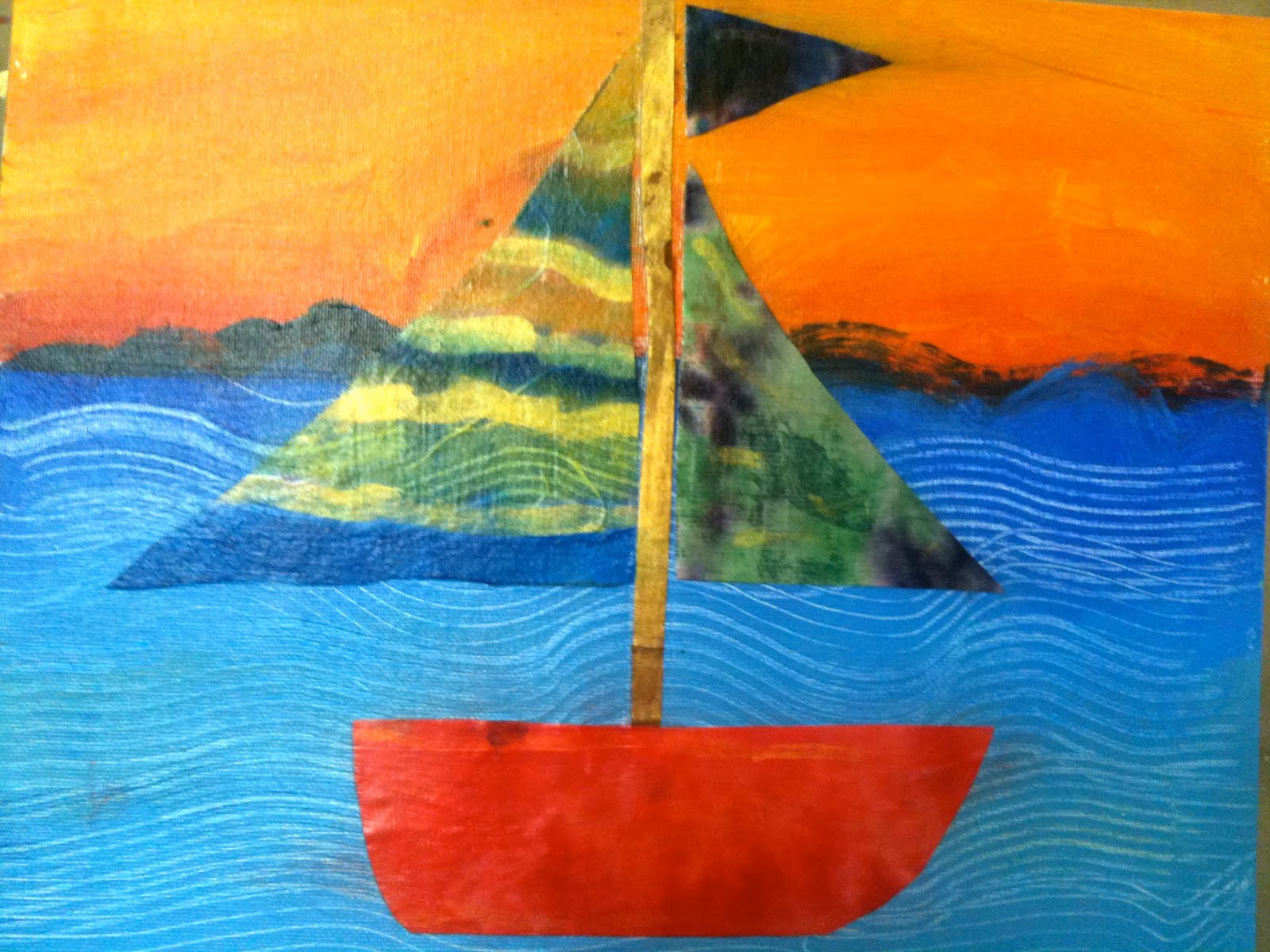
With the cool, crisp air making a surprise visit every now and then, I thought this lesson was a great way to say farewell to summer. I was inspired for this lesson my one of my favorite art lesson girls over at Mary Making. Here's my adaptation to Mary's lesson, Sailboat Collage.


First one hour session: Students used a 9 x 12 canvas board and acrylic paint with texture tool for the background. Lesson objective possibilities are introduction to landscape/horizon line, warm and cool colors, color mixing and texture. I focused mostly on landscapes and warm vs. cool colors. While paint was drying we pulled out some paper in various textures; some handmade, regular, watercolor, etc. We used liquid watercolors to mix and experiment. I put out different sized watercolor brushes, fresh water and spray bottles with a water/rubbing alcohol mix. Students absolutely loved this process.


Second one hour session: Decoupage glue and gold metallic watercolor liquid paint for accents. Students used painted paper and pre-cut stencil shapes and traced their boat parts, added gold highlights, and then after a quick drying time in front of a fan, glued together the collages. Lesson objective possibilities are introduction to watercolor, papers and mediums, collage, fine motor skills. These beautiful masterpieces were all done by 8 year old boys!


Sunday, November 22, 2009

Mixing Color with Kandinsky


'


I use this lesson with my older students (ages 3rd-6th) to practice color mixing and also to learn color theory. It's also great to introduce Wassily Kandinsky, patterns and rhythm. I use a square canvas and have them divide into nine square parts. We paint each square one of the following: (I only allow the students to use blue, red, yellow, black and white for mixing): primary colors, secondary colors, complementary colors, analogous colors, warm colors, cool colors, neutral colors, tint/shade of one color, and the last with colors of their choice. They have so much fun mixing and seeing the variations in color.


Friday, November 13, 2009

Van Gogh Clay Plaques


Here's another great lesson that I got from Dick Blick Lesson Plans online. I've done this project with students(ages 2-6th grade) several times and I always get great results. It's a great lesson to introduce Vincent Van Gogh and landscapes, basic clay and painting techniques and texture.


The above pictures are actual photos of Vincent Van Gogh's work-I show several of his landscapes to the students and let them pic their favorite to create. I'll let the pics explain and you can refer to the lesson plan on Dick Blick for more details. One tip is that I do encourage them to work on one small section of the picture at a time.


I thought their art turned out amazing!


Wednesday, November 4, 2009

Painting without brushes


This is a simple, but fun lesson that I got from 123 I Can Paint, by Irene Luxbacher. This book has some excellent lessons for younger students. I use this specific lesson to teach primary and secondary colors, as well as complimentary colors. It takes about thirty minutes, but if you want to let them actually mix their own secondary colors, you can stretch it out a bit. It's a great time filler and easy enough for 3-5 year old students. You will need color construction paper or I like the color railroad board, tempera paint, paper towels and a lot of 3 x 3 (or various sized) cardboard squares. Place a small blob of paint to the far left side of the paper (as high up as you want your building to be). I always demo this process once for the students---with the cardboard square, have the students pull the paint downward, off the edge of the paper. I usually put the complimentary colors beside each other so I can introduce this concept. Repeat this process across your paper, varying the colors and the "heights" or placement of the paint blobs-they can even overlap some to add perspective. Next, do a black blob of paint at the bottom and pull it across horizontally to make the road. Now with a wadded up piece of paper towel and some white paint, dab some clouds across the sky-they can even go over the tops of some of the buildings to make the sky scrapers seem "in the clouds". With the end of a paint brush, I have the students use yellow or white paint to add windows to the buildings, black paint for birds in the sky, and yellow for the lines on the road.

Thursday, October 29, 2009

Faux Batik


Here's a great project idea that I got from DickBlick. I've done these with kindergarten through 5th grade children. It does require a little more work on the teacher's part though because it's difficult to wash the glue off without washing off too much of the paint. I washed the glue myself and also ironed and hemmed the edges with fabric glue. For more details see:
http://cdn.dickblick.com/lessonplans/pdfs/gluebatik.pdf

You also might like....